


National Geographic 1945 July-Dec
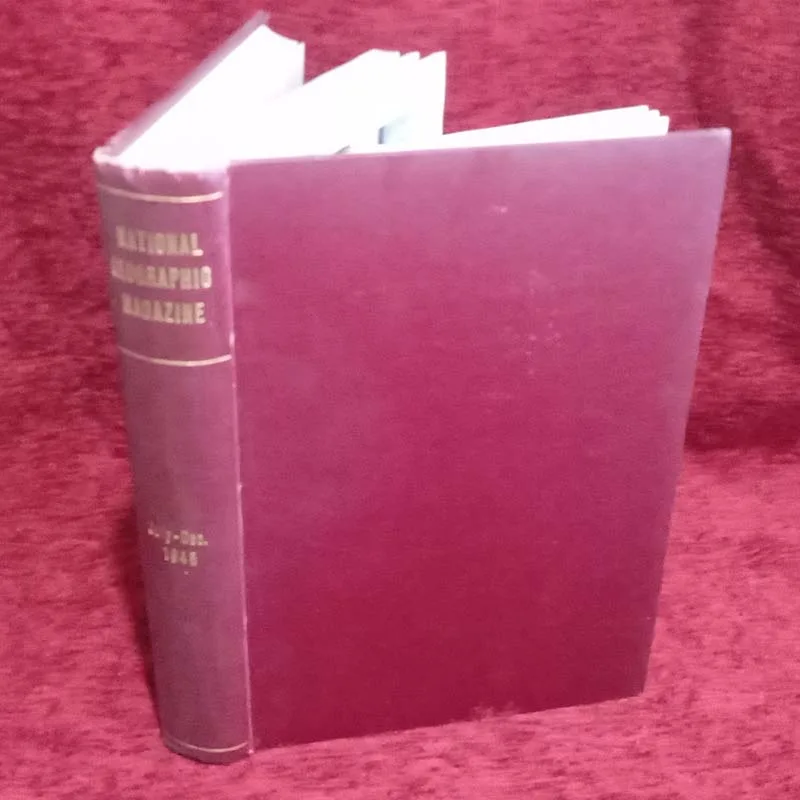
Publisher: National Geographic
Format: Hardback
ISBN: none
National Geographic, July–December 1945
Published by National Geographic Society
Condition: Good (meaning the war’s over, and so is most of the spine’s anxiety)
Proudly offered by Crappy Old Books, specialists in beautifully aged optimism and mild paper brittleness.
Welcome to the end of everything and the start of everything else — National Geographic, Second Half of 1945. The world was exhaling for the first time in six years, and this volume captures that glorious, awkward moment when humanity blinked, looked around, and thought, “Well, that was dramatic — where were we?”
In these six golden issues, the editors of National Geographic try to pivot from blitzes to beaches, from blackouts to birdwatching, and from world maps with lines of fire to world maps with new borders. You can feel the cautious relief between the lines, a kind of paper-based peace treaty between man and planet.
Inside, you’ll find:
-
“Victory Comes to the Pacific” — illustrated with photographs that look like they were taken by exhausted angels.
-
“Germany After the Guns” — an extraordinary mix of reportage, rubble, and relief.
-
“Home Front to Frontiers” — where GI Joe trades his rifle for a camera and writes lyrically about sunsets again.
-
“New Hopes for a Tired World” — a headline so bold they could’ve printed it on the moon.
-
And, inevitably, “Exploring the Amazon”, because National Geographic never met a war so global it couldn’t still squeeze in some monkeys and mud.
The ads are a marvel all their own — a capitalist resurrection in print form. You’ll see razor blades promising moral clarity, cars that apparently end fascism, and soap that will help “cleanse the world anew.” The paper is thick, the printing rich, and the whole thing smells faintly of peacetime ration ink.
Condition: Good, in the Crappy Old Books sense — which is to say it’s intact, dignified, and only mildly wrinkled by the weight of history. The binding has survived both world wars and perhaps one unwise attic, and the pages turn with that satisfying, faint crackle of real cellulose, not digital pixels pretending to be culture.
This is not just a magazine; it’s a global sigh bound in yellow. A time capsule from the moment humanity looked at the ruins, dusted itself off, and decided to start photographing penguins again.
Perfect for historians, romantics, or anyone who thinks the best part of civilisation is when it pauses to make maps.
Crappy Old Books — because peace, like old paper, ages beautifully if you don’t fold it too hard.
Keep browsing: See more National Geographic books Other books by National Geographic
